How to Check Pure Silk Saree Before Buying
You can tell real silk from fake by touching, smelling, burning a thread, checking the drape, and looking at the weave.
FRQ Editorial
FRQ Journal editorial team
Prices and shop details come from live FRQ listings and can change.
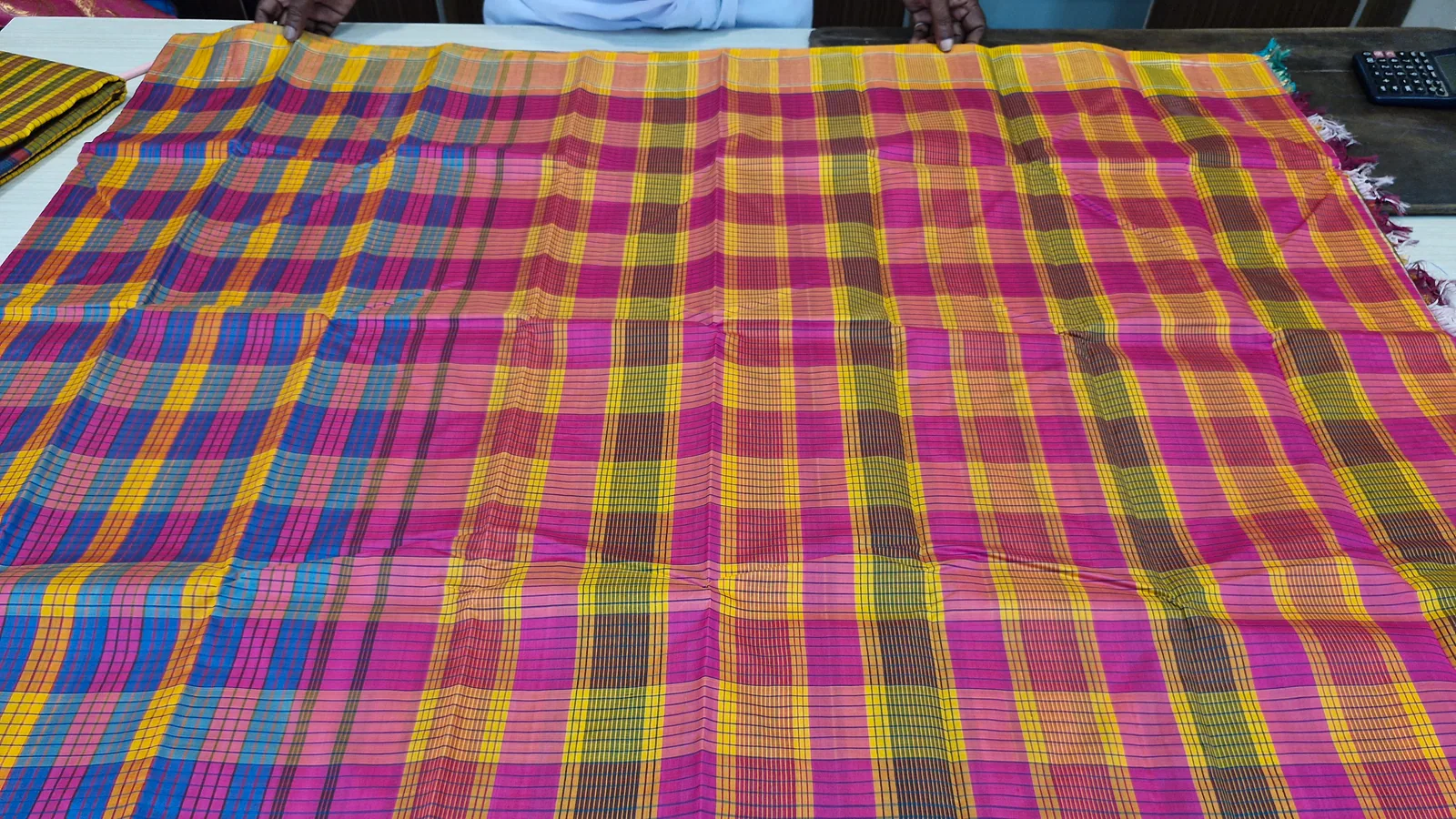
To check if a silk saree is pure, start with the touch test: real silk feels cool when you press it against your cheek and takes a few seconds to warm up. Next, pull a loose thread from the selvedge and burn it. Pure silk smells like burning hair and leaves a crumbly black ash, while polyester melts into a hard plastic bead with a chemical smell.
These two quick checks work whether you are standing in a shop in Jayanagar, browsing on FRQ, or trying a saree at home. You do not need a laboratory, just your hands, your nose, and a willingness to test a single thread.
How to check pure silk saree at home
The touch and temperature test
Hold the fabric against the inside of your wrist or your cheek. Pure silk feels distinctly cool, almost like a light breeze, and warms slowly. Synthetic silk, often labelled art silk or polyester silk, feels warm or neutral from the start and warms almost instantly.
The burn test
Ask the shopkeeper for a small loose thread, usually from the cut edge or the pallu. Light it with a match. Real silk burns with a smell of burning hair and leaves a dark, crumbly ash that you can crush between your fingers. Polyester shrinks, melts, and forms a hard, shiny bead that does not crush easily.
The look and slub test
Examine the weave under bright light. Pure silk has tiny irregular bumps called slubs, which are natural and uneven. It also has a soft, muted sheen that changes as you move the fabric. Art silk has a uniform, plastic-like glare and no slubs.
The drape test
Drape the saree over your shoulder or a mannequin. Pure silk falls in narrow, stiff folds that hold their shape and make a soft rustling sound. Synthetics drape in wide, limp folds and make little to no sound when they move.
How to check pure silk saree in shop
Ask for the fabric label
A genuine silk saree will have a stitched label stating 100% silk, along with the wash-care instructions. If the label says art silk, blended silk, or polyester silk, it is not pure silk.
Check the price
Pure silk sarees start well above ₹1,500 for basic varieties and go into lakhs for Kanchipuram or Mysore silk. If a saree is priced at ₹499 and claims to be silk, it is almost certainly synthetic.
Request a thread sample
A trustworthy shopkeeper will give you a small thread from the fabric for a burn test. If they refuse, walk away.
How to check pure mysore silk saree
Mysore silk is a specific variety of pure silk from Karnataka. It has a distinct gold or silver zari border and a soft, lightweight drape. The touch test applies here too: it should feel cool and smooth. Look for the Mysore silk mark or a GI tag if you want certified authenticity.
How to check pure kanchipuram silk saree
Kanchipuram silk is famous for its heavy weight and rich zari work. It feels noticeably heavier than other silks and makes a crisp, metallic clinking sound when the zari borders touch. The burn test is the same: a thread should smell like burnt hair and leave crumbly ash.
Common mistakes when checking silk
- Relying only on the shine: many synthetics are made to mimic silk's sheen, so shine alone is not proof.
- Skipping the burn test because it seems drastic: one thread is invisible and the shopkeeper will usually allow it.
- Confusing silk blends with pure silk: a saree labelled 70% silk and 30% polyester is not pure silk.
- Buying based on price alone: a cheap saree can still be pure silk if it is a basic weave, but an expensive-looking saree can be fully synthetic.
- Ignoring the drape: if the saree falls in stiff, narrow folds and rustles softly, it is likely real silk.
What to ask the shopkeeper
- Is this 100% silk, and can I see the fabric label?
- May I take a small thread from the edge for a burn test?
- What is the wash-care instruction for this saree?
- Is this a silk blend or pure silk?
- Do you have a silk mark or GI certification for this saree?
Frequently asked questions
How to check pure silk saree at home without burning it?▼
Use the touch test: press the fabric against your cheek. Pure silk feels cool and warms slowly. Then do the drape test: hold the saree by one corner and let it fall. Pure silk makes a soft rustling sound and forms narrow, stiff folds.
How to check pure silk saree in kannada?▼
In Kannada, people often ask 'is this silk or art silk?' The touch test works the same: real silk feels cool. The Kannada phrase for burn test is 'hoovu beledhu' (burn a thread) and real silk will smell like burning hair.
Can I trust the silk mark on a saree?▼
The silk mark is a certified label issued by the Silk Mark Organisation of India. A genuine silk mark label guarantees the fabric is 100% pure silk. Look for the hologram and a unique number that you can verify online.
What is the difference between silk and art silk?▼
Art silk is synthetic, usually polyester or rayon, made to look like silk. It feels warm, has a plastic glare, melts when burned, and costs much less. Pure silk is a natural protein fibre, feels cool, smells like hair when burned, and drapes in soft, narrow folds.
How much does a pure silk saree cost in India?▼
A basic pure silk saree starts around ₹1,500 and can go up to ₹5,000 for everyday wear. Mysore and Kanchipuram silk sarees start around ₹3,000 and can reach lakhs for heavily embroidered or zari-worked pieces. Always compare prices across two or three shops.
Discover authentic bazaar markets & local shops online.
See what local shops stock and what they charge, then visit the shop to check the item and pay at the counter.